He Jinbao Discusses Yin Style Baguazhang Forms
Yin Style Baguazhang is a formidable and mature art. Those undertaking its practice discover that its rewards are hard-earned and that a casual attitude prevents success. Contemporary life is far distant from the world of dynastic China from which Yin Style Baguazhang emerged; yet the art’s essence endures:it is an ancient fighting system of cruel sophistication. The forms of this style, like other elements of Yin Style Baguazhang, pointits practitioners toward this simple truth.
Whereas Baguazhang’s purpose as a pugilistic art is perhaps obvious, a thorough understanding of the system requires keen analysis.
He Jinbao says it is commonly expressed that Baguazhang’s theory is “broad and very refined”.
“The hands are well put together, strict in their applications,” he said. “Additionally, the art has a strong philosophical grounding to it; its contents are plentiful.The theory of the hand’s application and methods are intrinsically related to traditional Chinese culture.”
From the elevated theory of the art, down to the style’s physical postures and techniques, He Jinbao says there exists an inseparable relationship to traditional Chinese medical theory, the yin yang duality, five elements theory, and physics. Therefore, in researching the fine points of Baguazhang, He says one must spend considerable time trying to understand its basic principles.
The Originator
In examining this particular line of Baguazhang, one begins with the individual of whom this art is representative, Yin Fu.
“He was the originator,”said He.
His surname was Yin, given name, Fu. He was also known as Yin De An and Yin Shou Peng. He was born in 1840 and died in 1909. In his early days he enjoyed martial arts and practiced shaolin lohanquan, spring legs (tan tui), and a method of fast running and jumping now referred to as light body skills (qinggong). He was also familiar with traditional weaponry.
At that time - mid 19th century - Dong Haiquan, the creator of Baguazhang,was very famous in Beijing. Yin Fu learned of him and became his disciple. In teaching Yin, Deng took into account the arts that Yin Fu had already practiced and, in accordance with Baguazhang theory,tailored his training.
“He intended for Yin to absorb, take in, Baguazhang’s special principles and characteristics - in effect make manifest Baguazhang in Yin’s skills,” said He.
With Yin Fu’s own personality,talents, and instincts expressed in his practice, his bagua took a unique form that remains identifiable by certain traits, including the basic hand shape of the system referred to as the ox tongue palm (niu shezhang ). Also representive of Yin Style Baguazhang is a natural manner of stepping.
Yin Fu resided at Chao Yang Men Wai outside ChaoYang Gate in Beijing, and his art came to be known during his lifetime as East Side Baguazhang. The Bagua as practiced by Cheng Ting Hua’s was dubbed South Side Baguazhang - styles today regarded as the Yin and Cheng Styles respectively. Yin Fu went on to become instructor to Price Su, as well as to the Prince’s father, Guang Xu, gaining him fame as teacher of the Emperor.
Many disciples or students of Yin Fu became famous practitioners in their own right. Foremost among them was Ma Gui; he was followed by, in order of achievement, Li Yongqing, Men Baozhen, and Gong Baotian.
Cold, Crisp, Fast
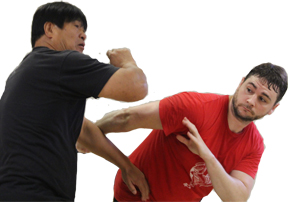
In describing the methods of Yin Style Baguazhang, He Jinbao emphasizes that they are hard and ferocious,employing what is known as the penetrating palm (chuan zhang), or the hard palm.
“The techniques are like iron, while transforming methods may utilize a silver hook (yin gou); that is to say, having the flexibility of silver.
“The art is talked about in terms of horizontal opening and angular entering. Entering is ona straight line, like lines with the sharp corners that comprise a square. The strikes are vicious, rash.”
The words customarily used to describe the methods of Yin Style Baguazhang are “cold”, “crisp”,“fast”, - traits prescribed by the system’s basicflavor, encoded into it’s very DNA. These characteristics are contained,notwithstanding a particular teacher’s point of emphasis or the favoredtechniques of individuals, in bloodlines extending back to Yin Fu.
“In explaining the flavorof this style we call Baguazhang we use terms that set it apart, definingit relative to other styles as unique, singular,” said He.
Hand techniques being ‘cold’ and ‘rash’ refer to the idea that in the midst of stillness an attack will begin unexpectedly - it occurs suddenly, surprisingly; cold in the sense that it is without forewarning.
“Crisp” means that techniques are short, exact, precise.
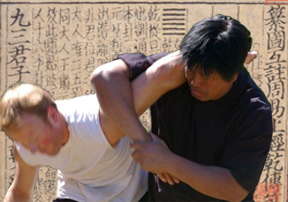
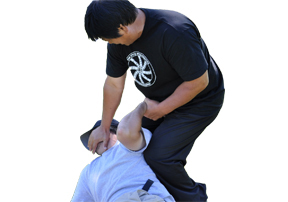
“If, for instance, you aregoing to throw somebody down...,” said He, “as soon as the hands go out the technique is applied, economically, without wasted effort. The opponent should fly right down, without struggle or tussle.
“What is meant by fast? What is the reason behind it? Many of our techniques take the straight, quick route to their destination; direct entry on a straightline. Whether it is hand techniques, forms, single actions, strikes - they all proceed on the straight line to get in and hit something.”
An example He often cites isthat in Yin Style Baguazhang one never withdraws the hands. Once a hand goes out it continues extended. “That,” says He, “is a way of guaranteeing you will have fast hands - you don’t pull back, you leave them out there. Not all styles have that.”
Nor do all styles possess a doctrine as comprehensive as Yin Style Baguazhang, it is sweeping and elaborate. Yet its composition is one of lean fiber - whole, taut, tested.
Leg and Waist Requirements
The role of the legs in YinStyle Baguazhang are well-specified; placement and accuracy of stepping,coordination of step with waist and body, and appropriate step positioning in relation to technique are strictly delineated. Moreover, procedures for increasing power through leg actions are also well-detailed.
“The leg methods of Yin StyleBaguazhang are what we call hard,” said He, “because we use a lot of moving with step ( a disabling advance applied in conjunction with arm attacks that undercut the opponent’s lower body) when we are striking.”
He Jinbao says that the emphas is placed upon stepping, and the degree of detail with which the subject is dealt, contributes greatly to one’s development of body skill (lively and well-integrated capabilities of the torso) and yields concrete effects when the art is applied.
“When the time comes to use your bagua, you get a big result,” says He.
The kind of outcome He Jinbao refers to can not be discussed without inclusion of the role of the waist; the great divide between the upper an lower body, and Baguazhang’s seat of power. He stresses that in Yin Style Baguazhang there are exacting requirements concerning its use.
The hands move with the turning of the waist. When turning the circle, the feet step in accordance withthe turning of the waist. The waist strikes and the waist removes. It is primary, it directs. From the point of view of Chinese medicine, the waist is the belt meridian whose twisting benefits the function of internal organs.
Yin Style Baguazhang’s regimen for waist development, if followed assiduously, takes practitioners a long way down the road toward realization of whole body force.
“The waist is the body’s biggest axle, so to speak,” says He. “As far as putting out or emitting force goes, it is the largest source.”
As regards the waist, He names it as one of five well-coordinated traits - hands, eyes, body, and stepping being the others - present in able practitioners.
Forms and Function
Without living witnesses nor pictorial documentation as evidence, the exact forms which Yin Fu himself may have practiced or taught are unknowable. However, Baguazhang is among the most youthful of traditional Chinese martial arts systems; Yin Style is but five generations removed from its namesake, and has not been subjected to the erosion of centuries. Here is an art, remarkable it its breadth and intricacy, that is likely as close to Dong Haiquan’s conception as exists.
Among Yin Style Bagua’s distinctions is that it is comprised of eight animal systems - each individually associated with a trigram of the Book of Changes
(Yi Jing) - thatare complete in their own right, yet combine to form a greater whole. The eight animals are, Lion, Snake, Bear, Dragon, Phoenix, Rooster,Unicorn, and Monkey. Each animal has 56 forms. He Jinbao explains that the forms of seven of the eight animals concentrate on palm or hand methods, while one animal, the Monkey, is concerned primarily with leg methods.
“There are many types of hand techniques.” says He, “The forms present different ways of combining them.”
Each animal employs eight attacking methods or strikes. These methods with their variations are represented by eight Chinese characters. For example, the Lion System includes the following attacking methods: sweeping (xiao), cutting (cha), chopping (pi), hooking (gua),shocking (pi), blocking (dang), seizing (qin), grasping(na). In this particular system each form is constructed primarily of a single character.
“As far as the Lion system goes... it is based upon the Qian Trigram with its three solidlines; it is long, very singular,” says He. “The forms put together one character at a time, they are not mixed up. In the case of the sweeping strike, you combine a number of sweeping strikes to make a form - it is singular in that sense. On the surface it looks simple, but the requirements for the use of force are, relative to other animals, quite a bit more strict.”
In contrast to the Lion, the forms of other animal systems, representative of their respective trigrams,combine two or more attacking methods.
As an illustration, He offers two of the Bear’s attacking methods - soft and following. “You will have separate forms for soft and following that contain both methods; but because one method will be predominant, one form is referred to as soft, another as following.”
The forms of the other sevenanimal systems bear an additional distinction - they are categorized as developmental in terms of either body requirements or attacking technique. For instance, the initial four characters of the snake system, shoulder, hip, elbow, and knee, pertain to the system’s body requirements. The final four characters, probing, holding, entrapping, and grasping, designate applications.
“The first four characters,”says He, “refer to body flexibility and nimbleness and how body skills are to be integrated, coordinated. And while the last four characters emphasize how techniques are used, that is not to say that the knee, shoulder, hip, and elbow are not for application. It is just that they are contained within the last four methods and to be applied in the blink of an eye; they are the tools of the last four methods.”
Yet another alloy of form and function is expressed in the Unicorn System. In this case the first four characters, sticking, adhering, soft, and following - unlike the Snake’s first methods which deal exclusively with body skills - combine both hand method and body skills .
He Jinbao notes that many kinds of forms have been created from the characters or attacking methods, but he stresses that above all, the forms of Yin Style Baguazhang are used for fighting.
From this standpoint, he says the forms can be grouped into basic categories that pertain to the moment actual contact is established with one’s opponent.
“The first kind,” he says,“we call a forcing entry. In this case, you could say, you yourself are primary. You are going according to your own plan, your own will. This is exemplified by the Lion - a lot of its forms and technique are of this mode.
“The forms of the Unicorn are characteristic of the second category. The opponent is primary. Of greatest importance is going with and transforming (the opponent’s force). These measures are shown very clearly through stepping, movement of the body, and the manner in which hand techniques themselves change from one to another.”
These two large divisions offorms increase versatility as they are combined with various stepping patterns.
Combining Techniques
He Jinbao says that within each form there are at least three combined hand techniques, and it is these very combinations which constitute a form. He says that some forms are interlocked for developing continuity, and some utilize hand techniques to enrich body skills.
But even when a form’s inherent purpose is known, it is not a static, inflexible construct. The forms of Yin Style Baguazhang contain but seven movements, yet they serve as a portal into a universe of possibilities.
“Once you’ve practiced to the point that you are very familiar with the form you can combine the techniques any way you want,” says He.
“Our forms use the very traditional way of putting together seven hands. Once familiar with these seven you can put them together cross-wise, mix them, reorder them.You can combine the stepping of one form with the hands of another. I often say that the forms are small because they are a set thing, but when you look outside them, at the combinations, they become much bigger.”
Unlike styles with long forms where certain individual techniques are extracted or isolated for repeated practice, Yin Style Baguazhang takes the opposite approach, placing emphasis on individual strikes which, when combined, comprise forms.
“We do things separately then gather them together to become complete,” says He.
“A good result will be gained if you practice basic strikes individually to develop power. Then when you practice forms, even though they will at first be unfamiliar, you will be well familiar with their components. And with knowledge of the applications of the basics, the form’s objective becomes clear. By keeping to this procedure your entire practice benefits, and as you add in different types of body skill and stepping, your usage capabilities increase. To be a complete bagua practitioner you must gain proficiency in the four major areas of training: standing, turning, striking, and changing or forms.”
As in a well-rendered song, where individual notes require clean, clear expression, the purity of single movements within the continuity of forms must be preserved. Moreover,the transition or interval between strikes provides additional challenges. “In concentrating on the combination of movements in forms you have to employ body skill and use of the waist,” says He.
Strategies
Fighting strategies and methods for applying force are the most tangible purposes of Yin Style Bagua’s forms - the countless contingencies of combat fall within their purview.
“You have forms for the idea of attacking;” says He. “forms for withdrawing; forms that dodge to a certain direction; force to a certain direction; forms that exert a rising force; others are lowering or heavy; others for transforming; we have the methods of snatching victory from defeat, and reversing the body; opening techniques; closing off techniques....“
Most importantly, says He, is to use techniques that one is “comfortable with, familiar with,”by definition the very techniques one ends up practicing most.
Contained within the forms are baiting methods to draw a response from one’s opponent so that a place on his body is vulnerable to attack. He says there are additional techniques that cause the opponent to “fall into emptiness”.
“I will bait you and cause you to lose your center,” says He.
Once the opponent is baited him into emptiness,”You want to strike him where he is exposed. In the midst of striking him you have to pay attention to what is open on yourself. Awareness of emptiness will help you be more complete, full, perfect in your practice of these forms.”
The individual strikes comprising Yin Style Baguazhang forms are sequenced to complement each rather than fall in a haphazard succession. Absent of floweriness or filler, their selection derives from a mentality or logic concerned wholly with practicality.
“The design of these forms have been laid out by the practitioners of past generations,” says He. “All you need to do is studiously, seriously, practice and add in your own thought. After ample experience you will achieve the idea of what we often say in Yin Style Baguazhang: The hands are very well knit and precise; the stepping is lively and flexible.
“Then, once you’ve added developed strength, you will get an excellent result.”
Practice a Technique One Thousand Times
Surely, excellent results are the goal of any serious pracititoner. But outcomes are influenced by individual objectives. Students who practice with health benefits,increased strength, or performance foremost in mind develop differently from those who train for fighting. Combat skills are the fruit of persistence; and repetition is the path to a well-hewn spontaneity.
“When the time comes to fight someone,” says He, “you don’t want to have any thought. You must practice a technique one thousand times to become familiar with it then another one thousand times to become tricky or to have the true art of it.”
He says that when one begins practicing forms, the physical aspect is large, and the intent or the mind is small.
“In the initial phase you are practicing the physical technique or force, getting force off. There will be relatively little in the way of intent. In the second phase, both aspects will be of equal amount. In the third phase the mental aspect predominates, the form will be well set.”
At this level one plumbs the complexities of striking. “Thought is more important, heavier,”says He.
“You need to be very serious. Be certain of the position of hand techniques and know where exactly you are hitting. Ask yourself if the body skills and postures meet the requirements of this trigram. Is there sufficient turning of the waist, concaving of the chest? Am I squatting down enough,heavy in the dantian? Are these things correct or not?
“Once you get to a certain level these things will occur naturally. It won’t feel right if it’s not that way.”
After progressing through stages,developing technique and intent, one’s tactile skills are enlivened. “You will be able to change according to the situation, feel what’s going on;” says He, “you will be able to concentrate on sensitivity.”
He likens this maturation to the development gained through turning the circle, where a once tense body becomes flexible, formerly clumsy stepping becomes agile, and chi and blood become unrestricted and flowing. “You have a higher degree of coordination. Your nervous system’s responsiveness will become better, more acute. This is referred to in martial arts as listening skills (ting gong). What it boils down to is in that instant when you exchange hands with someone you will have an intuition or feeling of what’s going to happen. As soon as the hands go up, you will break their technique.”
If one’s listening skills are lacking, this is the moment of truth. For one to still be thinking in that moment proves only that development is not yet complete. “There’s no opportunity to think,” says He, “no time to judge or decide what technique you want to use.
“Years of strict training are required to win with many of these techniques. You must practice well - to where you feel you have the sensitivity, have the hands -and can use them. That’s good practice.
“With many of the techniques we close off the middle and go to the side of the opponent, trying to reduce the amount of danger we face. As soon as the hands come up we’re moving. The traditional saying is: Hands form a cross shape and feet move in a circle.”
Deepening Comprehension
Based upon He Jinbao’s manyyears of practice and experience, he feels that unless students have gained a certain level of proficiency, accumulated enough capital, soto speak, it is of little use teaching some aspects of the art. He say that the methods and theories of Yin Style Baguazhang are understandable to a degree commensurate with a practitioner’s age, experience and progress; and that one’s understanding of these things change with time. But this kind of deepening comprehension is attainable by those who persist through years of training.
As an example of the evolution in his own thinking, He Jinbao offers the phrase: Between twoand five the development is real. He first heard this expression early in his training from Dr. Xie Peiqi and also came across it in the book, Orthodox Baguazhang Penetrating Palm, written by Xie’s teacher and a student of Yin Fu, Men Baozhen.
He says that when he was around twenty years old he thought that the phrase meant that between the ages of twenty and twenty-five is the optimum age to practice. Later he considered the ramifications of that interpretation: “That time will pass me by,” he thought, “how do you accept that once when you’re twenty-six”? He then regarded it differently, taking the phrase to mean that, “From two until five in the morning is the best time to practice because there are not many people outside then.” But then he wondered,“What if I can’t get up at that hour? Now what might that phrase mean?”
He Jinbao has pondered that saying throughout his life and now views it in the light of decades of experience: “Two refers to yin and yang, and five refersto the five elements,” he says. “I must get my development from within the context of these concepts.
“Another way of looking at the number two is as the necessity of having a second or following force(when striking). You can also say it refers to binary change,having two in everything you do. You might also say two refers to the Chen and Kun trigrams, the symbols from which the 64 hexagrams are created.”
Practice and Change
Practitioners of Chinese martial arts or wushu are well acquainted with the term gongfu. Translated literally as time and hard work, the term expresses an absolute distillation of what is required of anyone applying oneself to the art’s study. He Jinbao feels that often times student’s don’t face or confuse the reasons for their own lack of progress
“A lot of people blame the teacher,” says He, “saying the teacher is bad, or didn’t do this or that.... but frequently the student just didn’t use his heart to practice. Students aren’t held responsible for not practicing hard enough.
“Each teacher’s methodof teaching and way of thinking is different. For example, some will try to teach you a lot to see if you have a good memory. Some won’t teach much to see if you can take it or can endure.”
He says some students don’t practice things long enough to derive their benefits - they are impaired by a kind of ‘grass is greener’ mentality. “They can’t fix their mind on anything.” says He. “They practice this form but can’t resist looking at that one - they don’t know which one is good.
“I’m not saying you shouldn’t compare things. You should keep an open mind. It’s not simply a matter of the way that the teacher teaches you is exactly how you should practice. That’s just the beginning.”
He says that initially one should follow the teacher’s instructions to the letter. Then after “a long period of time” one should evaluate things through one’sown eyes and experience and practice accordingly.
All that is needed in order “to become good”, He tells his students, is to possess “the style,the flavor,”of Yin Style Baguazhang. “You don’t have to look exactly like I do,” he says.
“Add your own good points,specialities. Then you’re ok.”
He Jinbao said an instructor’s first duty is to teach accurately, so that students may better apply themselves conscientiously. For the student’s part, they must be able to “eat bitter - practice bitterly and studiously.”
“You have to be able to stick with it because in just a few years you won’t be able to experience all that is within this art.”
He Jinbao has seen his understanding of Baguazhang accrue over time. After thirty years experience he perceives depth, manifold meanings, and uses in teachings he once strained to comprehend.
In warning against complacency and ultimately, stagnation, he says, “It doesn’t matter whether we are discussing strikes or forms... half practice and half change. In other words, continuously correct yourself. Don’t forever practice in the same manner.