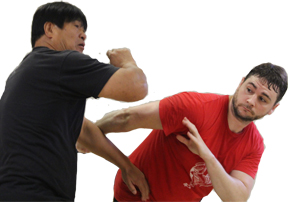
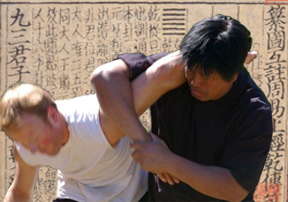
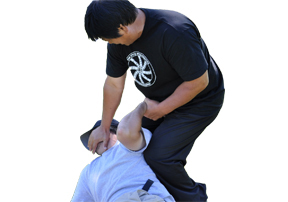
He Jinbao Discusses Yin Style Baguazhang Attack Methods: Seizing and Grasping
When considered merely as words, seizing (qin) and grasping (na) are not dissimilar – in fact, they are synonyms. In the context of Yin Style Baguazhang, however, these terms connote distinct attack methods.
Though the terms are commonly used to describe a similar thing, He Jinbao asserts that seizing and grasping pertain to different levels of development.
“That’s not to say one is higher than the other,” says He, “rather that there are different objectives of use.
“Seizing refers to a very fine or artful use of strength in achieving the goal of controlling the opponent -- he’s locked up, compelled to surrender. Grasping, on the other hand, leans more toward causing harm by permanently damaging connective tissue, tendons, ligaments, and to break or dislocate bones.”
Yin Fu
The line of baguazhang under discussion derives from Yin Fu, senior student of the art’s creator, Dong Haichuan. He Jinbao says that among the skills Yin Fu was reputed to possess was the ability to execute powerful, damaging seizing and grasping techniques merely by using his first finger and thumb; his squeezing strength generated force sufficient to harm the radial and ulna bones of an opponent’s forearm. This ability -- combined with a lean physique -- earned Yin Fu the moniker, Iron Handcuff Thin Yin.
As the most thoroughly taught student of a famed master, “Yin Fu obviously possessed very good gongfu (development),” says He. “The art passed down from him contains unique techniques, methods absent in other arts. Additionally the force employed is very complete, very much perfect. The techniques are refined; among them are abundant seizing and grasping methods.”
Yin Style Baguazhang is comprised of eight animal systems that constitute a vast art. Of those eight systems, only one of them, the Lion System, contains both seizing and grasping attack methods. The Snake System possesses grasping and entrapping (diao).
“There are numerous instances in Yin Style where one technique can contain both seizing and grasping, that is to say, the same technique can be used as a seize or a grasp,” says He.
“Outside our style, in other arts, ‘qinna’ is considered a single thing,” says He. “Therefore, depending on your perspective, these two may be viewed as techniques independent from each other, or as aspects of a single method.”
A Complete Martial Artist
Yin Style Baguazhang is an art as complex as an ecosystem with its many parts interacting and functioning as a unit. There are essential elements: the isometric standing strengthening postures (zhan zhuang), the circle turning practice for further development of strength and smoothness of movement, an array of strikes for virtually every contingency, and the changes which clarify the bagua methods of fighting. The training is well organized, logical and sequential. Using seizing and grasping techniques without proper underlying development is like attempting to build a tower on a bog. Accordingly, the seizing and grasping attack methods are positioned upon the solid ground of foundational practices.
“If you want to be able to use seizing and grasping,” says He, “You must practice development. You can’t lack training in your foundational exercises because what is spoken of in traditional Chinese martial arts is kicking (ti), striking (da), throwing (shuai) and grasping (na). And make no mistake about these four things -- you can’t talk about one being higher than the other. It’s just a way of describing, or getting a feel for different stages or levels of development.
“The idea you should take from this is that to be a complete martial artist you must be skilled at kicking, striking, throwing, and grasping -- you can’t lack any of those.
“In common terms, or to state what is most obvious -- if you’re far away from your opponent you kick; if you’re close you strike.”
Elaborating further on this way of thinking, He Jinbao adds, “If you’ve gotten very close or stuck to the opponent’s body you can go ahead and seize; or if you’re holding a vulnerable point -- break it.”
Yin Style Baguazhang’s foundational practices are well delineated. However, traditionally little is said about more sophisticated aspects of the art. These practices are illuminated through the light of experience and maturation.
“That’s the special point”, says He, “Even though we have seizing and grasping in this art, we talk more about striking than we do about grasping. Since seizing and grasping techniques are contained within the striking techniques we don’t talk about them.
“What it boils down to is that the technical content of seizing and grasping is very high-level, or quite complete, so you have to have all this stuff in place before you can gain that.”
He says that for techniques to be used efficiently in fighting they must be “natural” despite their toilsome development.
“It’s difficult to take all these complicated techniques and turn them into something simplistic, or easy to use,” says He. And he cautions against attempting techniques that are beyond one’s level.
“If in the beginning of your training you meet an opponent and try going right into seizing and grasping it’s probably not going to work,” says He. “You won’t see much good development. It doesn’t matter what you train or what technique or striking method you use -- the important thing is that whatever you’re employing, you have to have a very specialized type of force.
“In our Yin Style Baguazhang we have unique seizing and grasping methods such as plucking, wrapping, harvesting, and coiling around. These techniques all require very minute, fine changes in the force or power. If you‘ve not dedicated a long period of time to serious hard work and training to get that kind of force then it’s very difficult to reach the top point, the top rung of seizing and grasping.
Yin Style Baguazhang’s training regime for developing various required forces is neither mysterious nor vague, but rather as direct and discernable as a highway. In contrast to certain Chinese martial arts noted for their “softness”, Yin Style Baguazhang’s power is evident and the style is known as the “hard palm”.
While attainment of specialized types of force is proof of a practitioner’s focused dedication and resolve, He regards this level of development as a peak all should climb toward.
“It’s true this is a kind of specialty that qualifies you as a sort of expert in a certain area,” he says. “But that’s just one side of the coin. When training development we set our sights high; well-rounded practitioners possess seizing and grasping forces and techniques.
Specialized Force
Both seizing and grasping -- as do all of the attack methods of Yin Style Baguazhang -- include standing strengthening postures as a foundational practice. Included among its purposes is the development of specialized force. These static postures possess exacting anatomical requirements pertaining to the entire body.
“Practicing these postures will add to your internal strength, balance, coordination, and stability,” says He. “You’re also really refining a hand shape, working on a specific hand posture that you’re striving to perfect. The isometric pressures foster strength and are a means of training endurance; they contribute directly to the development of grasping and holding force.
“When practicing other strengthening postures, other hand forms, the objectives differ from that of seizing and grasping. For instance, when I practice, sweeping (xiao), cutting (cha) or chopping (pi), the focus is primarily on the forearm, the radial and ulna bones, not the hand. In seizing and grasping you’re emphasizing the back of the hand, the fingers and fingertips. Each attack method, or standing posture has as its objective a particular way of strengthening you.”
Turning the Circle
Yin Style Baguazhang has four major components of training that are equally important: standing, striking, turning, and changes. Since seizing and grasping are attack methods dependent upon strong foundational development, it is useful to view these methods within a larger context.
To have complete development,” He Jinbao says, “First of all you have to seriously turn the circle”, stating emphatically that it is “a profound practice.”
“If you want to reach the level where you can use seizing and grasping you must have the hands, body, waist, stepping, eyes, the concepts of hard and soft, all fused -- in addition to your experience -- together. The degree of ability you have in these things directly affects the result you get in seizing and grasping.”
“Through turning you produce more flexibility and nimbleness in the body and your sensitivity and reactions to things become more acute. Blood and the qi flow more smoothly and that, to a certain extent, can increase your ability to change techniques.”
According to the Five Element Theory of Chinese medicine, the Lion System corresponds to the lungs -- the organ related to one’s skin and hair. This has unexpected relevance to the animal’s seizing and grasping methods.
“In order to have good martial arts listening ability (tingjin), it’s important to put time in the turning practice,” says He. “I often say that when you make contact with an opponent the strength of your listening ability depends on the sensitivity of the upper layers of the skin and hair, the nerves, and your circulation. If you train well, the sensitivity of your hands will be very refined, your circulation smooth and unimpeded with the blood getting to the very end of your extremities, to each little joint of your fingers - this produces a very strong listening ability.”
He Jinbao says one’s visual acuity is similarly enhanced through the turning practice. He refers to it as a kind of training where both straight-ahead and peripheral vision is sharpened.
The “Director”
The turning practice may seem a baffling activity to the laymen but to seasoned practitioners its benefits are concrete and easily expressed. He Jinbao sees pliancy or flexibility as a defining characteristic of the art; and relates this attribute directly to turning or, more specifically, the development of the waist. The waist is the body’s nucleus commanding the operations of the torso and extremities.
“What it boils down to is coordination,” says He. “Coordination of movement. The waist is referred to as the “director” because its job is to coordinate the upper and lower parts of the body in a very nimble way. So when you talk about the body’s pliancy -- you’re talking about coordination. You have to understand what’s going on in the waist -- this requires being accurate in its use.
He says the basic advantage of turning the circle, simply put, is to transform a body that is stiff and/or has an impeded circulatory system into one that is flexible, mobile, with circulation flowing unimpeded. Moreover, stepping that is clumsy can become agile. Therefore, various changes in stepping methods such as: straight on, reversing, moving with or against force, advancing, withdrawing, may be readily accomplished.
“Also, arm requirements -- turning out, wrapping back in, drilling forward, pulling back -- can be improved by turning. It can benefit loosening, dropping of the shoulder, dropping of the elbow - you’ll deepen your understanding of these principles,” says He.
It’s apparent that turning has a broad-spectrum effect, profiting the eyes, hands, waist, torso, and stepping. However there are additional less obvious benefits. Turning requires an unrelenting coiled alignment of the waist. According to He Jinbao, this can improve the function of the organs as well as the function and changes of qi inside the body.
“In Yin Style Baguazhang we usually talk about training and development, not about qi itself; this can be likened to the reasoning behind our penchant for talking about striking, but not about seizing and grasping,” says He. But by not talking about something doesn’t mean we don’t have it. Certain things we discuss openly. Hidden within them are other things, not discussed. Some subjects are intended for people outside the style to know, others are meant for people within the style. We talk about striking, not about grasping. We talk about development, not about the movement of qi. We talk about the hands, not about the legs. Though certain things aren’t discussed they remain contained within the training. Through turning the circle you develop the waist’s twisting, whirling, walking, and turning. You gain recognition, understanding of, experientially, what is meant by the baguazhang tenets, the hands follow the turning of the waist and the feet walk with the movement of the waist.
“According to Chinese medicine, exercising the waist produces important effects on the kidneys such as fending off the organ’s premature aging, as well as benefiting the belt channel – these things mutually coexist. By strengthening the organs, health is maintained.
“By training over a long period of time you can increase and improve the flexibility and agility of the waist, the ability to have in harmony, or agreement, the upper and lower parts of the body. You’ll be able get a good feel for what is meant by the saying the waist is the director. Only by turning the circle can you arrive at a perfected use of the waist.”
When He Jinbao discusses seizing and grasping, it’s apparent that he cannot analyze them without thoroughly detailing the core features of the art, chiefly the role of the waist; the engine of the art’s attack methods. Yin Style Baguazhang strikes, the waist’s tangible extensions, are detonations of whole body unity and vivid examples of the art’s character.
“They (the strikes) give you a feel for the hard, firm, ferocious nature of Yin Style Baguazhang,” says He. “The force is very straight and the power is hard. By straight, I mean directly to the point. All palm techniques are interconnected, interlocked.”
This latter method is a key trait of Yin Style Baguazhang and a demonstration of the art’s rule to never withdraw an arm once extended. Strength is held against the opponent in one arm even as the next arm joins the attack. A high degree of flexibility in this method is a direct result of sound waist development.
He Jinbao describes the outlook of a skilled practitioner as, “Confident,
feeling like a mountain, powerful, great, unworried, as if in one burst of air you can repel an opponent. You can also experience the idea of reacting based upon what the opponent does -- you have the kind of courage that will allow him to attack first.”
Stepping
Roundness and twisting, prevailing characteristics of baguazhang, manifest in shape and step. The arms twist, the waist turns; the body is unified into a cohesive spherical entity - whirling and slippery.
He Jinbao says the “special thing” about this style is its maneuverability and unpredictability when applied during combat; “One may change, proceed along a circle, or move away at any movement,” He says. “This comes from the theory that says as soon as the opponent makes contact with you, you change, as soon as you meet force, you turn.
“Regarding change, any small way you modify the situation may constitute change. For instance, adding a following force to a strike is a change. If while moving in, the hand doesn’t move but you add force and continue entering – that too is an example of changing.
“In reference to turning when meeting force, what’s integral is the waist; it must function in any situation you find yourself in, it’s a catalyst enabling you to make use of the feet or the arms. ”
Stepping is used to adjust the positioning of the body, change direction or center of balance. Swinging open with the step is also a kind of changing. You can use stepping to reposition yourself to where you’ve got strength, or to maneuver yourself around the opponent -- this way you’ve achieved roundness.”
As a method of attack that transforms a disadvantageous situation, or losing position into a favorable one, He Jinbao sites the last tactic of the Chinese military tract, The 36 Strategies. He asks, “How do you get away from that, turn the bad position around?”
“There are many ways to move. For example, our squatting/contracting, or dodging body methods are based on stepping. In simple terms, all you have to do is move your feet. You could say a single step means you’re moving, two steps means you’re changing, and three steps is turning. Turning is the type of attack you do after you’ve met force from the opponent - you’re getting away from that. It has to be experienced through the waist; this Yin Style kind of flavor is expressed via the saying: the waist strikes, the waist removes. If you practice the martial arts, but neglect development of the waist, you’ll never reach a high level.”
Taking stock of the footwork or stepping in Yin Style Baguazhang, He invariably returns to the importance of foundational practices.
“If your feet are stable your whole technique is stable. And if your feet are flexible and agile, so too will be your changes. That’s why we put stepping in a very important place in our bagua. When discussing walking or turning you can talk about the height or depth of the technique, the speed of it -- you’ll need the ability to maintain balance when in the blink of an eye, in the midst of whirling or turning, you change between high and low, or fast and slow.
“In addition to how stepping works together with the body and the arms, it also has its own flavor or style to it; it contains - as far as kicking techniques are concerned - a very hard leg method. We refer to it as interlocking legs and straight on and reverse usage.
Philosophical Content
The ability to change or adapt to the fluid nature of combat is the essence of baguazhang. When oppositional forces converge violently, the stronger or more keenly adaptive fighter usually triumphs. Yin Style Baguazhang is a rigorous and well-thought-out system that provides myriad solutions for gaining tactical advantage. Yet just as these many strategies derive from a few basic ideas or themes, He Jinbao says all aspects of the art can be traced to its philosophical content.
“We say that YSB is a broad, all-encompassing thing, it has a lot of theory, a lot of things contained in it,” says He Jinbao. “Developed strength, fighting skill, each technique and posture, all stem from ancient Chinese culture: The Book of Changes, Yin Yang, Five Element Theory, Chinese medicine. They all play a part. Through training you’ll add depth and gain understanding of these things.
“But you want to keep in mind that each kind of theory and developmental requirement doesn’t just point to a single thing; they can address many things in the system. It’s not like you use a certain theory when standing that doesn’t apply to turning. It’s not like there’s some theory that applies to the forms but not to fighting.”
Though He views baguazhang’s theories as having universal pertinence, he does make a key distinction between training and fighting: “The difference is that when you train you want to be very serious, strict. But when you use it you should be relaxed, natural,” he says.
He Jinbao’s discourse on seizing and grasping exemplifies how these very methods are discussed far less than other facets of Yin Style Baguazhang and are, instead, brought to light through their emphasis.
He says that developing the quality of roundness, skill in turning, or other aspects of the art entail that they are thoroughly trained, experienced and re-examined.
“If you train well you should have a good feeling of being one solid entity, with circulation flowing evenly and smoothly through the whole body,” he says. “Likewise, thorough training in the entire art results in seizing and grasping skill. All I’ve laid out is the groundwork for seizing and grasping. It may look simple, but it’s actually complex. You have to listen well to your instructor, train a lot, use you brain to mull things over.”
Everything in it’s Own Time
Certainly, the seizing and grasping strikes themselves are not to be neglected. Individual strike practice is the core developmental method conferring force and precision. He Jinbao advocates a systematic and meticulous approach.
“In order to have really effective ability to control and grasp the opponent, to meet your objectives, you have to ‘take out’ or practice individually each technique and do it on its own,” says He. You have to practice the strikes over a long period of time. They need to be practiced accurately and regularly or by the rules. You should be able to analyze each movement and research it, test it out. Train repeatedly at this level and refine, refine, refine…”
There are eight attack methods in the Lion System of Yin Style Baguazhang: sweeping (xiao), cutting (cha), chopping (pi), hooking (gua), shocking (zhen), blocking (dang), seizing and grasping. Each method includes three basic strikes; together these form a comprehensive succession of attack options. The topic of this interview, seizing and grasping are, due to their required skill level, justifiably last in the training sequence. Though students of the art may be introduced to these methods, He Jinbao suggests they not overemphasize seizing and grasping prematurely; the strikes prior to them provide their basis and can in fact be employed to a similar aim.
In a like fashion, he says that the goal of the attack method, shocking, may be reached via different means. “Shocking is an internal strength,” he says. “From a developmental standpoint, it’s just a way of using qi and strength by sinking them down.”
The method itself isolates and cultivates a specialized strength that can, once developed, be contributed to other strikes.
“With this kind of skill,” says he, “as soon as the opponent’s hand comes up and you make contact, the seize will be there. So if you have those first four attack methods, plus shocking, you will be able to grasp.”
‘Everything in its own time’, might be He Jinbao’s general message. He advises students against being in too much of a rush, and says that preoccupation with distant skills at the expense of what is appropriate is wasteful.
“That doesn’t have much benefit when you’re training,” he says. “It’s like a lot of what’s happened to qigong practice in the last 20 years or so. People’s objectives have gone off into weird things and they’re unconcerned with what is realistic or required.
“All it really takes is to put in the time -- then you’ll naturally succeed.”
Development is, again, what He Jinbao is referring to: the time and effort that engender skill and depth of understanding. Furthermore, he exhorts practitioners to be flexible and clear of thought.
He says that implicit in seizing and grasping technique is a high level of coordination that allows for a wide range of changes. He asks rhetorically, “Why do I say that in the midst of striking is carried grasping?”
“Earlier I mentioned that the meaning of grasping is to harm connective tissue and separate or dislocate bones. But if your sweeping, cutting, chopping, or hooking strike is powerful enough to break bones it’s as if you applied a grasp; that’s the objective of grasping.
“Don’t be so narrow-minded to think that seizing and grasping is just using the fingers or hands to do some type of a lock on people . . . that’s not it. If you have a solid foundation, very solid developmental practice and power, you could use a straight chopping palm for instance and go ahead and break bones, harm muscle connective tissue and such. That also would be the idea of grasping.
“If you chop somebody’s qihu point or on the neck and knock them out - that’s the idea of grasping; you could call that seizing and grasping, or that through point striking you’ve arrive at the objective of seizing and grasping. If you knock them out with a chop, what’s there left to control?”
“My goal in this discussion is to provide a broader and more complete understanding of what seizing and grasping are. No matter what you train in, you want to be without misunderstanding. Why do people misconstrue things now? For one, many books that are written don’t really accord with the rules; and in any case, it’s not like one or two books can really explain what’s going on in the martial arts. It’s like any subject - there are levels of understanding, there is shallow and deep.”
Perspectives on training are subject to individual assessment; shades, distinctions, and order apparent to the expert are often lost on the unpracticed. He Jinbao reminds us that while skills are developed systematically, insistence upon inflexible, black and white explanations is often not beneficial. Rules provide guidance but only experience reveals the wide vistas.
“Open horizontal, enter angularly’” says He . “First you have to open (the opponent), then you enter. It doesn’t matter what you ultimately do; first you have to make preparation, clear the way. Another saying is, close off the straight on and force the side. The objective is to get away from the opponent’s attacking hands. Yet another theory we have is to avoid the heavy blows and let the light ones fall. Though many things are similar, they should be viewed proportionately, relative to circumstances. That’s the way to consider seizing and grasping - the idea is to attack; but base it on your own situation and use it however you want.
“After years of training exclusively in Yin Style Baguazhang, these are just my personal conclusions.”