YIN STYLE BAGUAZHANG


When asked why the complete art of Yin Style Baguazhang in not widely known, He Jinbao of Beijing China, says simply,  “Few have practiced it, and few are left to teach it.”  This art, he says, is characterized by six words: stable, accurate, viscous, cold, crisp, fast. 

The obscurity of the style should not, however, suggest its lack of importance nor its deficiencies.  To the contrary, modern martial artists may conclude that Yin Style Baguazhang is unparalleled in its comprehensiveness; an art who’s richness lies beyond the capabilities of this author to convey.

Baguazhang translates as Eight Trigram Palm and was first taught publicly by Dong Haichuan during the nineteenth century.  Dong’s first and most extensively taught student was Yin Fu, whose name now specifies this style.  This particular line of bagua was passed on from Yin Fu to Men Baozhen, and from Men Boazhen to Xie Peiqi.   Dr. Xie, now 82 years old, has designated He Jinbao, his student of thirty years, as the lineage carrier. 

He Jinbao says that although he is well acquainted with other widely practiced branches of bagua such as the Chung and Liang  styles he feels qualified only to discuss the Yin style, adding with bemusement that while visiting the U.S. he has observed additional bagua styles of which he had formerly never heard. 

Eight Animals

The art of baguazhang is based upon the Daoist philosophies of China, and the ancient text, Zhou Yi (Book of Changes) . ”That’s where the theory of the art comes from,” says He   “Each of the eight trigrams of theYi Jing has a corresponding animal in Yin Style Bagua.  Each animal is a complete system in its own right possessing its own personality, skills, applications and functions, including different ways of putting out force.“

The eight animal systems each contain eight attacking methods or strikes characterized by the trigram they are based upon. As one might expect, the animals also include ‘forms’; these short combinations of fighting techniques make up for what they may lack aesthetically with  unequivocal functionality .The forms training is comprised of training levels progressing from execution with power to a more flowing method where power is contained but not fully expressed.   

Yin Style Baguazhang’s first animal is the qian trigram lion system, known as the interlocking palm.  The term, interlocking, signifies force applied against an opponent that is without gaps even as it changes, so that there is no opening for one’s opponent to take advantage of.  The Lion is pure yang energy or hardness, and is one of two animals represented by a pure trigram, the other being the Unicorn.  Bagua literature defines the Lion as, “Top - bottom, internally - externally, unified into one qi.  Both arms are put out with extreme force.”

The Lion’s eight strikes are: sweeping, smashing, chopping, hooking, shocking, blocking, seizing, grasping.  “The Lion,” says He,  “Is powerful and ferocious. Its power is a full body force. Its way of putting out force is to emphasize the waist. “  The Lion is often the first animal taught  as it develops muscles and tendons more rapidly than the other animal systems.

When speaking of Yin Style Bagua strikes in general, He Jinbao stresses that there are many different ways of practicing them. A comparative example being, “moving with” and “moving against.”  The former he displays by executing the chopping strike where his forward arm and waist move in the same direction. Then chopping with his rear arm, his arm and waist move in opposite directions. Though He is stationary while executing the strike, the wooden floor he stands upon can be felt shaking from eight feet away.  He JInbao explains further that, “Contained within the moving-with-force is also a moving-against-force, and that inside the moving-against-force exists moving-with-force.”  There are also, he says, “Horizontal and vertical force.” 

The kan trigram snake system is referred to as the flowing or moving with the force palm.  “It is a winding kind of force,” says He, “With many techniques employing hidden hands.  The snake’s eight strikes are: shoulder, elbow, knee, hip, shooting, winding, holding, grasping. This  animal is characterized by a smooth and flowing quality, with many of its strikes aimed at the opponents vital points.   

The bear belongs to the gen trigram and is referred to as the turning the back palm.  He Jinbao says the bear is distinguished by a strategy of “Taking advantage of a losing position, snatching victory from defeat.”  The bears eight strikes are rushing, penetrating, withdrawing, carrying, leaning, shocking, soft following.  Its method for emitting power is to use the back. He says the bear’s force is, “Very short, or blunt.”   

The Zhen Trigram Dragon System is known as the lifting and holding palm.  Its eight strikes are as follows:  pushing, lifting, carrying, leading, moving, capturing, chopping, entering. He says the Dragon’s power, “Is emitted  through a forward motion of back and waist.”  He further defines it as a stopping or upward force  -  a containing force, externally still and internally moving.”   The Dragon, He observes, though different from theYin style Dragon, is the animal practiced in Cheng style baguazhang.    

The Xun Trigram Phoenix System is known as the windmill palm. To emit force the shoulder is emphasized. The Phoenix’ eight strikes are characterized by a whipping action and are,dodging, extending, chopping, shocking, transforming, removing, curling in, stabbing.      

The Li Trigram Rooster System is called the lying palm or lying-step palm. This particular step requires long, deep footwork, with one’s body near the ground suggestive of a person lying down.  The Roosters eight strikes are: dodging, extending, lifting, shifting, entering, whipping, rushing, stabbing. The rooster’s force emphasizes the elbow.   

The kun trigram unicorn system is designated as the reversing the body palm. Being antithetical to the Lion, the Unicorn is pure yin. The art’s literature defines the Unicorn as, “Top-bottom, internally-externally smooth and flowing.”

The Unicorn’s eight strikes are comprised of, sticking, needing, soft, following, hip, striking, chopping, cutting.   It issues force by employing all joints to produce a kind of a flexible, snapping power.  He Jinbao says the Unicorn is, “Soft, yet strong.You can use the wrist or elbow to put out force, perhaps rotating or transforming the opponent’s force. Because it is very relaxed and loose you can be very fast with the techniques. There is a shooting like quality to the strikes.”   

The Dui Trigram MonkeySystem concentrates on leg technique and is referred to as the interlocking leg.  Its  eight leg strikes are winding, stomping, popping, hip, chopping, swinging, cutting, stamping. This last strike suggests a kind of finality.  In Chinese, He says ‘stamping’ may also be translated in a more colloquial way as, “It’s over.”

When considering that each animal system contains three variations of eight individual striking methods and that the strikes may be combined in countless variations, the scope of Yin style baguazhang is brought into focus.   

Four Benefits

He Jinbao believes that regardless of what style of martial art one practices, the art should not diverge from the basic precepts of:

1) Strengthening one’s body,

2) Improving one’s health

3) Developing one’s ability to fight, and

4) Preparing one to display their art in a visually pleasing way. 

He emphasizes that while martial arts have far reaching benefits, one must be alert to potential hazards. “In the beginning of practice the initial result will be that the body gets stronger and you will continue to strengthen and grow as you practice.  However, practicing incorrectly may yield the opposite effect  -  you could actually hurt your body.” 

He distinguishes between strength and health, saying that the latter, too, will improve with continued practice. “There are many important things to get out of training, says He,  “But longevity is very important.  Pay attention to the normal circulation of blood, breathing; the  health of heart and lungs.  Those who overtrain or move excessively should slow down and ‘gather’.  You should take into account your age, constitution, how long you’ve been practicing and how much each day in structuring your training to reach the goal of a healthy body.”   

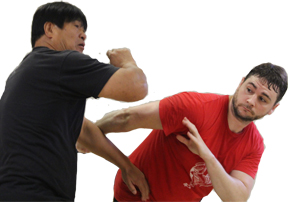
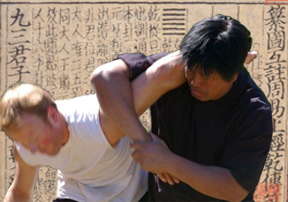
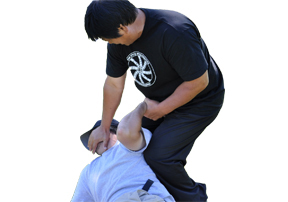
Perhaps due in part to the advent of the performance art dubbed “modern wushu” and the prevalence of ill-trained gongfu “masters” or those insincerely touting the importance of application, some question the legitimacy of the Chinese systems as fighting arts.  He Jinbao’s efforts to promote the value of Yin Style Baguazhang invariably reveal his combat skills.  He is agreeable to challenges and possesses a spirit and abilities that tend to allay doubts.

“It doesn’t matter what martial art, style or system you practice, you should know how to apply it,” he says. “The Chinese saying goes, ‘Whatever you study you should be able to use.’  Only if you know how to employ your martial art can you raise your practice  -  bring it to another level. And by practicing well you will be able to apply your art even better.  Your usage skills can also be seen as a way of measuring your growth or progress.”   

He Jinbao dislikes the term “performance” when describing the demonstration of martial arts. “I  feel that performing is something you do for others,” he says.  “When you are practicing for yourself, observers will as a result notice more fullness in your movements. You ask yourself,  do my techniques feel good,  are my movements rounded and smooth, do I feel good after I practice?  Once you reach a high level it (your gong fu) should look good to other people because it feels good to you” 

Four Basic Practices

To understand the architecture of Yin Style Bagua it is necessary to examine the four basic practice methods pertaining to each animal: standing, turning, striking and changing.  These practices exist as the art’s four great pillars, and He says that they are to be considered of equal importance.  

The standing practices involve nine static strengthening postures specific to a given animal. Each posture requires precise body alignment and distinct isometric pressures necessitating whole body exertion.  These postures are undertaken to, “Develop and check the structure of every part of your body, “ says He.

The strengthening postures are characteristic of the demands of yin style baguazhang and might prove eye opening to those who construe “internal styles” as arts deemphasizing muscle development.  He Jinbao contends that if you are able to hold a posture for more than a minute you are likely practicing incorrectly or not working hard enough.

“You should try to reach the goal of being externally still but internally moving,” says He.  “And through standing you are strengthening your body and making it more effective for fighting -  strong enough to withstand blows.

“Yin Style Baguazhang is considered an internal martial art so it requires that your feet have roots and that your qi is sunk.  It’s very different than long fist styles where the qi actually rises and you’re always preparing to jump in the air and kick high.”

Through the series of postures one’s entire body, seemingly every cell, is engaged in a kind of twisting dilation.  For example, the Lion system’s first posture  - Lion Opens Its Mouth - strengthens the rib and intercostal region, expanding and fortifying it. 

He says that by dropping one’s qi the abdomen gains strength. He feels that by being exact in one’s body alignments and paying attention to internal sensation, “You get things moving and experience a kind of self massage of internal organs.  And when you have to execute sudden or violent actions your organs will be strong and able to tolerate bouncing around . You can avoid becoming dizzy or nauseous.  No matter what style you practice your outside should be strong and powerful as well as your inside.”  To illustrate his conviction, when He Jinbao assumes the Lion Opens its Mouth, his rib area feels not unlike stone.  

The second primary practice method, turning, or what is sometimes referred to as ‘walking the circle’, is the practice many people associate with baguazhang.  “It is both the most basic and the highest practice,” says He.

“The first goal in practicing turning is to find the harmony between man and earth.  If you practice daily in the same location you adapt yourself to the four seasons... whether It’s cold or hot you don’t say ‘Im not going to practice’.  In martial arts the most important thing is to not be lazy.  You also cannot be afraid of hardship.  These skill are not an easy thing to attain.  You must endure a lot of suffering. 

“Yin style bagua is the art of striking as you are moving.  You ceaselessly move and strike, and are always trying to get to the outside (of your opponent) or always turning.   No matter what  - position yourself to avoid the heavy blows and let the light ones fall.  It is within turning that  movements and techniques are honed to perfection or to a high level.  All movements and techniques are linked smoothly together.”  

The third primary practice, strike training, “Is the basic or foundational method of developing power,” says He. Yin style bagua students are introduced to this practice with the ‘stationary drilling method’. As the name suggests these strikes are executed unaccompanied by footwork. ”This method”, says He, “Establishes the harmony between hand and waist.”  

Yin style baguazhang’s array of strikes are practiced individually and in various ways effecting a fusion of stepping and striking.

“Do it a thousand times until it becomes familiar to you.” says He,  “And only then will you be able to use it.  Only by practicing a technique with different types of body methods, hand methods, stepping methods, and from all different angles, will you be complete and flexible in your striking.”  

The striking methods are organized systematically with increasingly complex footwork. The muscular development and body alignment forged through the strengthening postures is now manifest in stationary and moving strikes.

As the strengthening postures strikes provide the foundation for the stationary strikes, similarly the moving striking practices are predicated upon the stationary strikes. Among the functions of the moving strikes is establishing the harmony of hands and feet.  “If hands and feet arrive at the same time,”  says He, “Your opponent will leave  - your body movement is unified.”

The moving strike practices consists of:

1) One-step drilling method; of which there is the zig zag stepping or dominating the side, straight stepping or dominating the center, closing or turning the back method. 

2) Two-step or square drilling method which consists of advance-backstep, advance-advance, backstep-advance, backstep-backstep. 

3) Three-step  or horizontal drilling method which combines the stationary strike, advance step, and backstep. 

He Jinbao says practicing the moving strikes with their assortment of footwork results in each strike executed more accurately and with more power. “You can take something you like and practice it a lot and in many different ways. You take things you connect with and that you will be able to use effectively.  Only if you practice correctly and fully will you be able to use it,” says He.

In analyzing Yin Style Bagua’s diverse strikes and footwork one would be hard pressed to expand upon its repertoire; it’s eight animal systems seem like a catalog containing every conceivable strike in the human arsenal. 

Changing can be regarded as the very essence of baguazhang.  It is exhibited perhaps most obviously in the interchanging of left and right hands, but as He Jinbao says, changing additionally includes one’s exchanging of force. He presents the example of an attacking strike such as the sweeping strike changing to a more defensive function as a capturing strike.  “I’ve always heard from my teachers that if you want to beat people you have to have a second force. You can defeat a lot of people with one force but it won’t be as effective as having a second.”

This kind of observation, explains He, is based in Chinese culture. Horizontal and vertical forces are intrinsically different.  Vertical force is referred to as preheaven.  ”It is an easy force because it’s very natural,” says He, “Force going outside or along the horizontal plane is post heaven, and is more difficult to develop. Still, no matter if it’s pre or post heaven, you have to practice it all -- this way you can be complete.  Changing also pertains to alterations in your stepping, the exchange of hardness and softness, the conversion of long and short.  There are lots of ways of changing.  If you have many changes in your relationship with your opponent you can confuse and take advantage of him.”    

He Jinbao believes that no matter what martial art one practices there are four basic progressions or stages of development: 

1)Yang fire, which can be defined  as “hard” or obvious power.

2) Yin fu, which may be referred to “soft” or unobvious power. 

3) Practicing your spirit to return to emptiness -- or combining yang fire and yin fu. 

4) Accepting the qi from heaven and earth.

“Whether you are practicing hard or soft, both must combined to be complete,” says He,  “Only then can you raise your level. If you are too hard you are easily broken, and if you are too soft you are without force or strength. You must have both.  All that you do is a combination of strength and skill.  If you depend only on strength others will acquire skill and be able to beat you.  Relying on strength alone is low level.  To really take advantage of opponents you should have not only good strength but also long practiced skills.”  

He Jinbao says true skill is present when one’s art is an extension of oneself and is expressed naturally, and that this achievement facilitates even greater improvement.

Though one’s ultimate potential is perhaps unquantifiable, skills are developed by adhering to an exacting regimen. 

“In this practice you have strict rules or measures,” says He.  “Yin style bagua requires that you must relax your shoulders, drop your elbows, concave your chest, round your back, fill your belly, roll your hips under, lift your anus. Every hand technique has ways of changing into other techniques.  To develop strength in your feet when you turn or step, grab the earth with your toes and concave the yong quan point on the bottom of your foot. From the context of Chinese medical theory, by hollowing the yong quan point you are gathering qi.

To develop muscles and tendons in your arms and generate twisting force in your hands, your applications contain rolling and turning over, extending and pulling. Your waist must have twisting, whirling, turning, and moving.  Your foot work must employ lifting, placing, swinging, and hooking. In all your actions your posture is to remain low. 

“No matter what quan (style) you train in, concentrate on practicing gong , or getting good strong development. This includes holding individual postures for a long time to get maturation in those postures.  A common saying in Chinese martial arts is,  ‘If you practice quan but not gong  -  when you get old your fist will be empty. If you practice gong without qi  -  when you become old all you hard work is wasted.’  

He Jinbao feels that he has taken many “wrong turns” in his own training and desires to save his students from similar struggles.  The instruction he received was not always transmitted systematically nor accompanied by much explanation.  In his quest for understanding, He has met and interacted with many old martial artists of Beijing, at times culling information from them, confirming that they were in agreement before being satisfied with his own interpretations of baguazhang.  Among those old masters still alive, He names, Li Shiqiang, Yang Kun, and Li Rong. 

He’s introduction to martial arts was in xiyangquan, a style originating in Henan Province.  He says his original teacher is someone he will always hold great respect for because after training He for two years acknowledged that he could take the teenager no further in his development and offered to introduce him to a more skilled teacher. 

Introduction to Baguazhang

Having never even seen baguazhang before, He Jinbao arrived at Xie Peiqi’s home totally unfamiliar with the style. Xie was drinking tea when He asked the master if he would instruct him.  Xie inquired, “What kind of strength do you have?” and rose from his seat to get a closer look at the fifteen year old, feeling his arms, examining him like a piece of meat.   He Jinbao says he was a rather skinny boy, but Xie said to him, “You can practice the Lion.  Lets go out to the courtyard.:

“Xie did a series of five or six movements and told me to repeat them,” said He, conveying with gesticulations the speed with which Xie executed them.  “I  couldn’t follow what he had  done and apologized explaining that it was all new to me and I didn’t  know what baguazhang was.” 

Xie then quickly repeated the movements making no allowances for He’s confusion. Now He attempted to follow Xie’s techniques but he was no less perplexed and once more pleaded a lack of comprehension.  Appraising He with disdain, Xie asked,  “Why are you so stupid?” Xie then - before going back into his house to resume drinking tea  - struck He several times revealing the applications to the elusive movements.  He remained outside determined to practice.  Eventually Xie called out to ask how He’s practice was going.  “OK,” said He, concealing his uncertainty.  “So go home and practice,” said Xie. 

Determined to be better prepared for his next encounter with Xie Peiqi, He  began going to a park where bagua was being practiced.  Unaware that the art was represented by different branches, he applied himself unknowingly to a style other than the Yin style. 

A week later, He arrived at Xie’s home with confidence bolstered. 

“Have you been practicing?” Xie asked.

He said he had, and began doing a kind of circle walking - called ‘mud stepping’ - he had observed in the park.

“What is that?” asked Xie. 

“Bagua,” answered He.

“Where did you learn it?” 

“In the park.” 

“Then go to the park and learn,” said Xie. 

Only then did He realize there were different bagua styles and that Xie taught theYin style.  Xie said Yin Style Baguazhang uses “Natural stepping, small steps, a small circle.”

Despite the inaupiciious beginning He’s bagua training was to continue; he thereafter met with Xie every Sunday.  Xie’s favor, however, would not be easily gained, He says he was often ignored by Xie in his early years of study. 

For the next five years He trained diligently under Xie, in time feeling competent enough to practice among other martial artists in a park.  In 1976 one day after practice, an unimpressive man who had watched him train approached him.  “He looked like a country bumpkin” said He.  “I was very surprised when he asked if what I was doing was the Yin Style.  When I said that it was, he further surprised me by inquiring if I was a student of Xie Peiqi. Then he asked me why I was practicing incorrectly, and said that I will never be able to use my bagua  the way I was practicing.

The stranger introduced himself as Liu Fang.  I had heard of him and knew that he was a famous student of Xie’ so I said, ‘I’ll study with you’.  Liu Fang said, ‘don’t talk like that, you’re Xie’s student ‘. I said,  no problem”

As it happened some friends of He’s knew Liu Fang and later accompanied He to his home where he was again rebuffed by Liu.  Ultimately the situation was resolved when He Jinbao asked his teacher if he objected to him receiving Liu’s help.  “Xie said he didn’t care,” said He.

“The first time I went to his home to actually receive instruction,” said He, “Liu Fang said ‘let me see you practice’.  Then he asked me some questions.  All my answers according to Liu were very poor, and he said ‘you study bagua but  don’t know anything’.  He said that I can’t practice stupidly and should instead give thought to what I’m doing.”

Liu Fang had spent ten years studying bagua, ten years studying xingyiquan, and ten years studying paochui (the style paochui, not the form from Chen style taijiquan).  He was a highly trained martial artist.  “Liu told me to show him my sweeping strike,’” said He.  “ He said that I should strike his arm.  I did, but not forcefully.  I didn’t move his arm at all and Liu said ‘that was nothing, try again, use some force’.  Because I was being polite, I struck  but again held back.  Liu repeated, ‘you have nothing’.  So I  swung my arm as hard as I could and saw that just before making contact with Liu’s arm he turned it a little.  I  felt a shocking pain in my arm and a welt immediately developed. Liu then said I was the first person willing to put real force into a strike aimed at him.  He advised me to continue studying the Lion with Xie, and that he would ‘show me some stuff’.

Subsequently every Sunday He went to Xie Peixi’s home in the morning and Liu Fang’s in the afternoon. “Liu was well educated and taught meticulously, said He. He was a very good teacher and he helped me to understand Xie’s art.  From him I learned a lot of fine points, such as developing force by striking into empty space rather than by striking objects. 

Seek Naturalness

The phrase, “seek naturalness,” occurs frequently in He Jinbao’s discourses. He says that if one is uncomfortable or losing one’s breath when practicing it shows movement and breathing are not coordinated.  He advises that students be patient and proceed one step at a time, that being anxious or impatient can in fact impede progress.

“You want to be very strict with your practice and requirements to develop strength and force,” says He. “If hand and foot don’t arrive at the same time you won’t have a full expression of your force. Only after developing harmony, then in the end after a long time will you also be powerful even if you happen to put your foot down before your hand.

“A given hand technique may be executed high, low, or in a long or short fashion, but you want to deliver it in its most effective way.  For example, if when fighting or applying force you are too high, your structure and joints won’t be in the best place, resulting in impact on your body and joints and unnecessary injury. Pay attention to getting your strikes to the most accurate position. Many strikes in yin style bagua are going to appear round yet project straight.  And many strikes will have a second force behind them to change their direction or quality.”

He Jinbao often says to his students to practice a ‘fist’ or technique is very easy, but to develop a kind of force is very difficult.  Moreover, he says the responsibility of educating students that befalls a teacher is not onerous, but changing a student’s bad habit is very difficult.   

Use your Brain

He Jinbao says every strike in YSB is represented by a Chinese character that possess broad and deep meaning.  The sweeping strike ,xiao, for instance, can also be interpreted to mean cutting.  He likens the entire arm in this strike to the blade of a knife.  The chopping strike, pi, he said is like an axe, ”The blade is short but very heavy.”  By rotating a strike, upon impact it gains a “whirling force; It’s like a screw or a drill that eventually penetrates the opponent.  If you put out a fist  -  it should go out like a cannon.” 

Despite the intricate details of movement and structure, discussing baguazhang purely in terms of its physical requirements would be a disservice to this venerable discipline.  He  says that as an internal martial art, bagua doctrine stipulates that one augment one’s technique with “real intention” and have a clear idea of what type of force one is issuing.

”For that matter, regardless of what style of martial art you practice, I feel you should use your body as well as your brain,” said He.  “If you use only your body and not your brain, you yourself won’t understand what you are doing. And if you just use your brain, any technique or anything else you do will be fake. 

“It’s common sense  - skills come through practice.  If you cheat your practice - your practice will cheat you. Regardless of what kind of skill or martial art you study, you must be very serious, hard working.  Be it China or America, in the endeavors of study everyone is the same under Heaven. Martial arts have been passed on through many ages and over centuries.  They have been expressed in many different styles and forms. But no matter what martial art you are training in, they all employ their theories and practices to reach the same place.”