YSB in the U.K. - London Intensive 2009

By Dr. Jim Lindsay Ph.D.
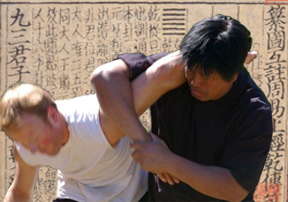
He Jinbao teaches a seizing technique to Jim Lindsay and Johan Gabrielsson

As is well-known to its practitioners, Yin Style Baguazhang is a deep and complex martial art requiring an intense personal investigation in a wide variety of difficult, complicated practices to meet even the basic training requirements well. Those requirements, though, are what give the art its elegance, efficiency, and potent efficacy, and many years of serious effort and careful study are needed to achieve proficiency in the art's four training pillars: strengthening postures, striking, turning, and changing. For the sincere, dedicated practitioner, these fundamental practices serve as the incredibly firm foundation upon which the layered complexities of the art stand, creating martial effectiveness paralleled in potency perhaps by no other fighting style in the world.

The intensive held in London in 2009 was designed around the goal of developing those basic practices on a variety of levels, and the execution of that design by He Jinbao and Matt Bild was thorough and complete beyond even high expectations. Here, I'd like to share some of my experiences with the intensive.

Jim Lindsay applies grasping technique on Justin Noppe
Building the Foundation

The London intensive incorporated a remarkably efficient design scheme that allowed its participants to develop both specific and general competences in the foundational practices of Yin Style Baguazhang. In particular, the first four days of the intensive were geared directly around building a solid foundation on the standing strengthening and the single-action strike

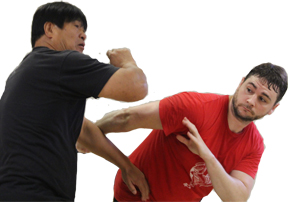
He Jinbao attacks Khan with rolling shocking strike

practices of the eight striking methods of the Lion System. The standing practice was thorough and intense to the point that I'm left in absolutely no doubt of why it is called "strengthening practice," and I'm now quite clear on its tremendous ability to transform a practitioner both physically and mentally without the need for supplemental exercise routines. Significantly, Jinbao took time to describe both health-building and body-building aspects of the standing practice, including a discussion on how the Lion's representational posture, among other things, has the power to develop both the musculature and the bones of the forearm in order to turn it into a tremendous weapon, detailing carefully what must go into training that posture to achieve that goal.

In striking, Jinbao put particular attention on proper form and execution of the techniques, as would be expected, and shared a considerable amount of detail into the theory of the Lion System -- as depicted in the Book of Changes by the Qian (Heaven) Trigram -- particularly in the avenue of the proper method of finding and routinely generating the waist-driven forces of the Lion System. To paraphrase him for example: "The Qian Trigram is pure Yang, which indicates tautness. The tautness is present throughout the wind-up of the strike and builds through the action of the waist as if a towel or spring is being twisted to its limits. When the position is correct, the tension finally snaps, the body suddenly relaxes, and the full power of the waist explodes out. Then, the solid, heavy, full force of the Trigram is present again as the strike concludes." He combined this seamlessly with salient demonstrations and discussions on the importance of stability of the body and efficiency in movement, taking time to present both the details of how to seek forces ourselves as well as the common mistakes that must be avoided.

He Jinbao attacks Justin Noppe with a rising blocking strike

This theoretical description of the proper method of finding and producing the forces of the Lion System combined with Jinbao's meticulous attention to the accuracy of the mechanics of the strikes made a powerful and real change in my ability to coordinate my body and feel the exciting beginnings of just that kind of strength in my striking. Notably, he put particular emphasis on paying attention to the five aspects of coordination that make for successful training and execution of the techniques of Yin Style: hands, eyes, body, waist, and stepping. In fact, according to the members of my group when I returned home, the change possible in just a few weeks of that kind of scrutiny is stark and unmistakable, which leaves me eagerly anticipating how I'll develop as the months and years go by -- now fitted with a much clearer vision of my potential than ever before. As an added bonus, Jinbao took time to explain for us some of the differences and similarities between the forces and theory of the Lion that we were studying and forces and theories of all of the other animals' systems, providing contrast and an indication of things to come if we are serious enough to make the Lion System our own.

He Jinbao locks Justin Noppe with a rising sweep strike before executing knockdown

These four days, however, were not purely theoretical discussion and rote repetition of basic drills. Each session included a lively discussion and practice on the basic applications of the emphasized striking method. We explored several variations in use of the strikes, ranging in complexity from the very straightforward to significantly more subtle, providing a realistic feel for each of the striking methods, its goals, and its potential results. For instance, by just the end of the second day of training, I had new-found clarity on the underlying similarities and important differences between the sweeping and hooking palms, to say nothing of my increased grasp of the importance and value of training strikes with stepping for creating successful utilization of the strikes. Of course, there was also a strong emphasis on clarifying the connection between the accuracy and intent of the strike-drilling practice and the effectiveness of the related application, bridging the illusory gap between drilling and usage.

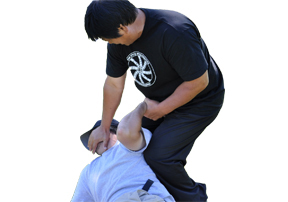
Jim Lindsday maintains control of Justin Noppe after a knockdown
Putting Things Together

The main body of the London Intensive lasted nine consecutive days after a short break from the initial four, giving participants a chance to mull over the lessons of the foundational practices. Each of the nine days was quite effective in developing a higher level of ability and usefulness in the system without having to deviate from the basics. As a matter of fact, the combination strike drilling focused upon in the nine-day portion of the intensive truly made the twenty-four basic strikes of the Lion System simply come alive for me again.

He Jinbao attacks LamboW with a breaking blocking strike

In these nine days, the mornings' sessions focused upon combining the basic strikes of each palm into three-strike combinations, which were organized in a variety of ways that were both challenging and yet obviously and realistically applicable. As expected, we practiced these drills heavily enough so that it's fair to say that, for a fair proportion of the participants, many of the routines began to feel both natural and powerful. Then Jinbao would often have us move on to another variant using the same strikes in a different order, challenging our coordination, expanding our thinking, and developing our ability to adapt and temper our minds to changing circumstances. We worked this way with all six basic striking methods of the Lion System: sweeping, cutting, chopping, hooking, shocking, and blocking, and the last two palms, seizing and grasping, got two days of their own in which their natural role as finishing techniques was the focus.

LamboW attempts to throw Jim Lindsay during shuai jiao training

The striking combinations practice each morning culminated with Yin Style's ultimate expression of technique combination: forms practice. Instead of shotgunning the intensive with a large number of forms in a variety of attacking methods, the intensive featured only two forms: Windmill cutting and Reversing the Body shocking. Both were drilled extensively and with significant attention to detail, elucidating both the correct execution of the techniques as well as the underlying theoretical flavor of the form. For me, the ideas of what "Windmill" and "Reversing the Body" mean are vastly more clear than they ever have been, and I look forward to putting that understanding into the other forms of those flavors in the future. Particularly, within the Windmill forms now, the echoes of what little of the Phoenix System I have seen are clear and unmistakable, as is the underlying adherence to the rules of the Lion System that make it unique.

He Jinbao executes seizing technique on Justin Noppe

To round out the training, each morning's practice began either with a session of standing in the Lion's posture, deepening the understanding gained in the previous week's practice, or with a session of turning in the same. I was particularly impressed by the level of detail that Jinbao gave in the proper methods of turning the circle, revealing a bit of what is meant by the saying that it is both Yin Style's most basic and most profound practice, both martially and as a health-building exercise. Yet again, I'm forced to say that a practice that had slipped into becoming routine for me was reborn into something I am very eager to delve much more deeply into and expect to get far more out of.

He Jinbao instructs Jim Lindsay on an arm binding technique

The afternoons in the nine-day intensive were set around crystallizing the lessons of the eight striking methods with long, serious applications sessions emphasizing the combination of proper techniques with appropriate stepping to achieve the goals of cold, crisp, and fast strikes and knockdowns. We were strongly encouraged and directed to learn the feeling of each of sweeping, cutting, chopping, hooking, etc., and to focus on their proper usage in more complex applications than studied in the four-day portion, including combining one striking method with another. As with everything in this intensive, the development was systematic and the level of detail offered was unparalleled in any of my experiences in a Yin Style seminar. By the end, I felt like I had made incredible progress in my ability to apply the striking methods of this art in a fairly wide variety of ways, including the ability to switch from one striking method to another as the situation might change. Furthermore, one of my favorite parts of this portion of the intensive was that some degree of creative exploration was encouraged once the basics were grasped. Jinbao and Matt would come around and personally evaluate application experiments and offer keen insight and modification that greatly enhanced the whole experience, especially the effectiveness of the techniques. Ultimately, we were also instructed to start to learn which applications felt more useful to each of us and to focus primarily on getting skilled at those, helping to personalize our training.

Justin Noppe controls Jim Lindsay with an arm bind

After applications, for eight of the nine days we were treated to a course in developing technique with the large saber, training both basic drills and the Nine Dragon Saber form. Like every other part of the seminar, this segment proceeded in a logical, thought-out manner: interweaving the strengthening saber drills with the more technical performance of the form, building it up section by section in a level-appropriate way. For me, the attention to the liveliness of the footwork necessary for properly practicing the saber truly stood out as a lesson to help me draw closer to the coveted goal of making myself and the saber act as one.

He Jinbao uses seizing technique on Khan

As a bonus in these afternoon sessions, since the London group has a set of very nice mats for applications, we took time to build up our strength and sense of center with some shuai jiao between applications and saber practice. Though not a part of Baguazhang, this side-bar to the training was quite valuable and exciting for developing a different kind of whole-body strength and a realistic feel for the balance required to maintain against and potentially overcome a resisting, aggressive opponent, bringing that reality to the minds and muscles of the participants.

Bringing It Home

For me, when I attend a seminar on any topic, I find it very important to be able to sit down both during and afterward and really focus and reflect upon what I get to bring home from it. On top of the obvious increases in skill and technical proficiency that came with the training in London that I did this summer, I can honestly say that this intensive gave me more to take home with me than the vast majority of the learning opportunities I've had in my life. In particular, the great organization and careful execution of the intensive provided me with curriculum to bring to my group as well as sufficient competence in the skills we practiced to be able to reliably demonstrate and pass on many of the lessons that we studied. As a senior member of my study group, it is exciting to have gone to a seminar and returned home knowing that I have more than just a few weeks worth of excellent, solid material to cover with my training partners but instead have plenty to last for months or years to come. It is especially special that, by the very nature of the curriculum we can design from this intensive, our group will be able to inspire and properly initiate new members as they join. Simultaneously it should continually reignite the excitement of learning the system for those of us that are more established, in many ways as if for the first time, just as I felt it spark up again in myself while toiling away in a lovely park in Central London under the June sun.

Jim Lindsay executes knockdown of LamboW About the author:

As of 2009, Jim Lindsay has been training in Yin Style Baguazhang for three years and is a founding member of the study group in Knoxville, Tennessee. He recently finished his Ph.D. in mathematics and works as an instructor at the University of Tennessee in Knoxville and as a freelance writer.