Yin Style Bagua, like all traditional Chinese martial arts, is comprised of four main components for fighting:

Kicking

He Jinbao kicks Scott Berry - Ann Arbor, MI

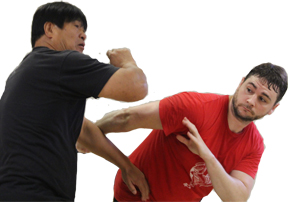
Striking

He Jinbao executes a blocking strike to Matt Service - Beijing, CN


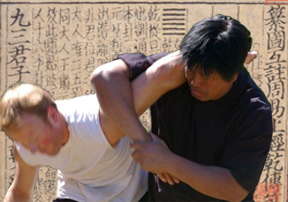
Throwing

He Jinbao seizes then throws Kevin Kennedy - Stockholm, SE


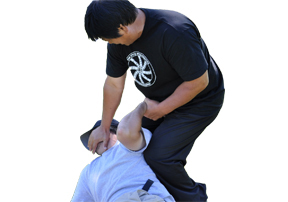
Grasping

He Jinbao grasps and controls Scott Berry's elbow and leg - Ann Arbor, MI


Yin Style Bagua practitioners develop these four fundamental fighting skills through the the following practices:

Strengthening Postures

Blade Sackett stands in the lion system isometric strengthening posture - Phoenix, AZ

These postures are taken from the eight animal systems of Yin Style Bagua. They develop strength through isometric tension, and help to improve the flow of blood and qi (vital energy) in the practitioner’s body.

Circle Walking Practice

Nick Luchetti trains lion system circle walking - Boulder, CO

Turning the circle is what makes the art of bagua unique among all martial arts. It is used to train agile stepping for fighting, improve the practitioner’s circulation and coordination of waist, arms, and legs.

Striking

Dan Crescenzo trains a bear system rushing strike - Northampton, MA

Strike training is key to the combat effectiveness of Yin Style Bagua. Strikes from the various forms in the eight animal systems are broken down and trained individually and in combinations. It is through this practice that Yin Style’s formidable power is developed.


Changing

Bryon Powers executes a snake system change - Beijing, CN

Changing can include: technique, stepping, or use of force. Each of the eight animal systems in Yin Style Bagua has 56 forms drawn from the 8 attack methods of that animal system. The training of these forms allows a practitioner to develop a smooth and effective ability to change during a fight. As bagua is the art of striking while moving, changing puts together the skills developed through strike training and circle turning.


Weapons

Yin Style Bagua includes the practice of various weapons, the most notable of which is the large saber

Kevin Kennedy executes a chopping saber technique - Stockholm, SE

Weapons in Bagua are unique in that they are considered an extension of Bagua's empty hand techniques, rather than seen as a separate system, as is the case with many styles. Saber training can help practitioners to develop full body strength, coordination, and endurance